
AI-powered creative testing is rapidly changing how marketers evaluate advertising. By combining artificial intelligence with synthetic data, these platforms enable faster, more cost-effective, and more informed creative decisions than traditional consumer research.
However, not all synthetic creative testing platforms work the same way.
At one end of the spectrum are tools that ask marketers to describe a target audience and then evaluate creative using a small number of AI-generated personas or generalized creative norms. These tools can provide quick feedback but often offer limited transparency into how recommendations are generated.
At the other end are platforms built on statistically representative synthetic populations. Rather than relying on a handful of personas, these systems evaluate creative across an entire simulated population that reflects the diversity, behaviours, attitudes, and decision-making patterns of real consumers. This produces richer insights, greater analytical depth, and more actionable recommendations.
Before adopting any synthetic creative testing platform, marketers should understand two critical components:
- The data — What synthetic data is being used? Is it statistically representative? How was it created? What variables does it include?
- The methodology — How does the platform generate its recommendations? Are the algorithms transparent and explainable, or does the platform simply return a “winner” without showing how it arrived at that conclusion?
Without transparency into both the data and the methodology, marketers should be cautious about relying on the results.
Arima’s Approach
Arima takes a quantitative, user-driven approach to creative evaluation using its proprietary Synthetic Society™ — a statistically representative, privacy-safe synthetic population that mirrors the demographic, behavioural, geographic, attitudinal, and psychographic characteristics of real-world consumers.
Rather than replacing marketer judgement, the system is designed to augment it by providing evidence that helps improve creative before it goes to market.
The process is straightforward.
Step 1: Define the target audience
Marketers build their audience choosing from thousands of available variables, including demographics, behaviours, attitudes, interests, geography, media consumption, lifestyle, and psychographics.
Step 2: Select the evaluation dimensions
Creative can be evaluated against any combination of attributes relevant to the campaign, including:
- Brand fit
- Brand attribution
- Message clarity
- Audience relevance
- Uniqueness
- Emotional appeal
- Likeability
- Memorability
- Purchase intent
- Any other custom evaluation criteria
Step 3: Evaluate every member of the audience
This is where Arima differs from many synthetic creative testing tools.
Instead of comparing creative against a few representative personas or broad creative benchmarks, every selected evaluation dimension is assessed against every synthetic individual within the defined target audience.
The result is a quantitative measure of how well the creative aligns with the preferences, motivations, behaviours, and psychographic profile of the entire audience.
Example
Suppose a marketer wants to compare two creative executions against four objectives:
- Brand fit
- Emotional appeal
- Memorability
- Audience relevance
The target audience is defined as:
Single females aged 30–49 who are adventure-seeking travellers.
Within Arima’s Canadian Synthetic Society™, this audience contains approximately 960,000 synthetic individuals.
Each piece of creative is evaluated across all four dimensions against every member of this audience, producing the following scores.
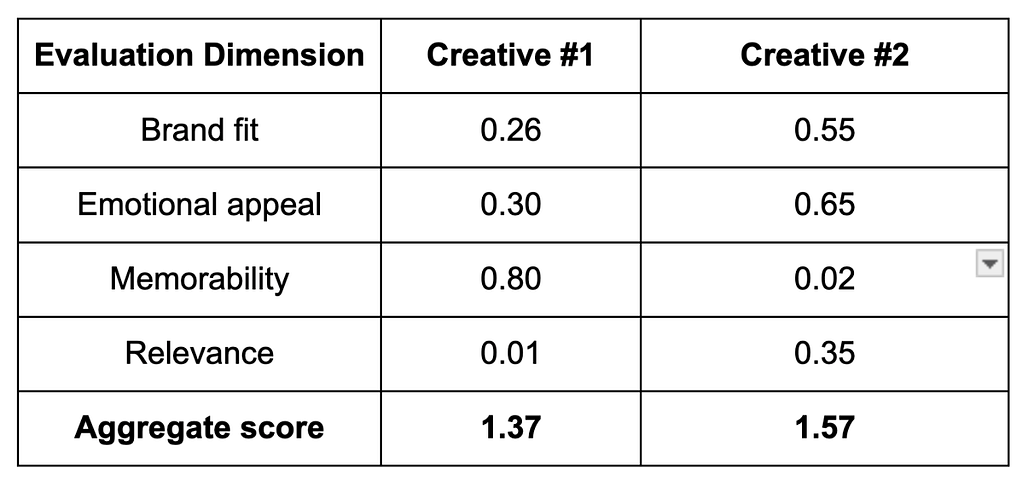
Creative #2 achieves the higher overall score, but the analysis goes well beyond identifying a winner.
The dimensional results reveal why each execution performed as it did:
- Creative #1 is highly memorable but lacks relevance to the intended audience.
- Creative #2 demonstrates strong brand fit and emotional appeal but is unlikely to be remembered.
Rather than simply selecting one ad over another, marketers gain specific direction on how each creative could be improved before launch.
Why a Population-Based Approach Is Better
A synthetic population approach offers two important advantages over approaches based on a limited set of AI-generated personas.
1. Every audience member contributes to the evaluation.
Instead of relying on a handful of representative personas or generalized benchmarks, each creative attribute is assessed across every synthetic individual in the target audience, producing a more comprehensive measure of audience fit.
2. The outputs are diagnostic, not just directional.
Rather than returning a single recommendation, marketers receive dimension-level scores that explain why a creative performs well or poorly. This makes the results actionable, allowing creative teams to refine specific aspects of an execution instead of simply discarding it.
The result is a creative testing process that is more transparent, more quantitative, and ultimately more useful for making informed marketing decisions.